The
acquisition spotlights two Southeast Asian ‘buddies’ whose journey in hotel
investment is steadily rising.
INTERNATIONAL
REPORT – Usually it's the big brand that buys the small one. The recent
acquisition of two Belmond hotels by KS Hotels and HMD Asia is like fish
scooping up pelican.
The
deal thrusts the two Thailand-based partners into the limelight as Southeast
Asian investors that are expanding their hotel ownership in niche destinations
in the region, focusing on unique product, social impact and local service
culture.
It’s
no surprise they went after Belmond’s La Résidence Phou Vao and La Résidence
D’Angkor when the chance arose. The hotels fit like a glove with their
investment ethos. Both investors are also familiar with the lay of the land,
Laos and Cambodia. The former property is located in Luang Prabang, the ancient
capital and UNESCO heritage city, while the latter is in Siem Reap, home to the
extraordinary Angkor Wat temples.
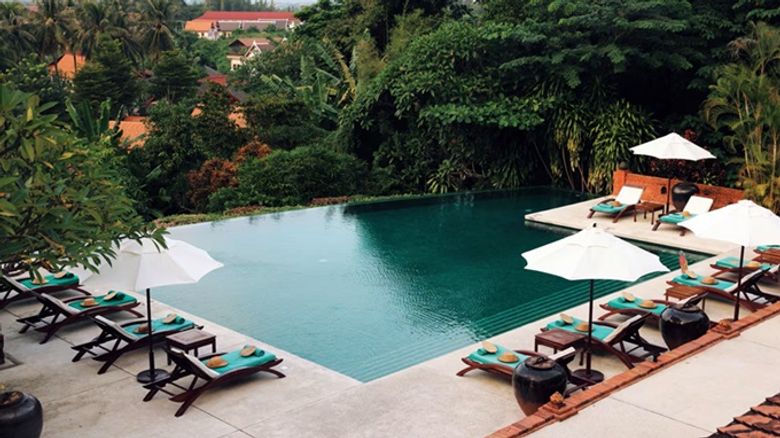
La Résidence Phou Vao, Luang Prabang, Laos
Such
deals are rare, Sokoun Chanpreda, founder, owner and managing director of HMD
Asia, told Hotel Investment Today. “The opportunity to acquire these two iconic
hotels arose post-COVID, which we believe was unique and would never have been
available, and thus it was an interesting investment opportunity,” he said.
“Our
dream hotel ownership is precisely the nature of this La Résidence deal –
hotels that have history and brand recognition, where we can respect the past
and embrace the future, nurturing our service culture, guest experiences and
growing the business,” Chanpreda added.
The
price remains undisclosed. Belmond would not comment on why it let the hotels
go, having even renovated the 56-room Le Résidence D’Angkor just before the
pandemic. The hotel is closed since the pandemic and will reopen in 2025 when
the new owners complete a refresh of its exterior and interior areas, including
putting in new amenities in rooms, said Anthony Lark, executive director of HMD
Asia, who oversees the hotel management business of the company. The 34-room
Luang Prabang hotel is open, with HMD Asia managing the property effective
November 1 when the sale was completed.
Belmond
is left with two hotels in Asia, in Bali and Samui, although it still operates
a couple of Eastern & Oriental Express journeys in Malaysia and Singapore.
To some observers in the Asian hotel industry, Belmond’s hotel development
appears to be more focused on Europe, the Middle East and South America than
Asia.
Responding
to Hotel Investment Today, Belmond said it “continues to explore opportunities
to enhance our portfolio with exceptional journeys and iconic properties in
Asia.”
A
push factor for Belmond may be that Siem Reap is still struggling to recover
fully from the pandemic as the China market isn’t back in force. What’s worse
is an overhang of room supply from a building boom between 2016 and 2018 as
developers saw a rising tide of Chinese visitors to Siem Reap.
Chanpreda
described the oversupply of hotels in Cambodia and particularly Siem Reap as
“the biggest challenge” for the hotel sector. “Banks are cautious based on this
oversupply,” he said.
Nevertheless,
he sees value in having a new brand addition to the portfolio. “The outstanding
reputation of our team at both Shinta Mani and La Residence gives us a
marketing edge,” Chanpreda said.
Pioneering
spirit
The
acquisition isn't the first between two “best buddies,” HMD Asia’s Chanpreda
and KS Hotels’ Owner and Managing Director Eddie Kiasrithanakorn. They
previously partnered together in around 2005 on Hotel de la Paix in Siem Reap
(now Park Hyatt) when the destination was still a new frontier.

I think Eddie and Sokoun have realized that there are opportunities for them to grow their partnership together as hotel owners. One such opportunity is La Résidence,”
Anthony Lark
Their
pioneering spirit endures. Apart from the latest acquisition, KS Hotels owns or
co-owns 10 luxury hotels in Thailand, Laos, Maldives and Australia. According
to a 2009 disclosure by IFC, part of World Bank Group, the company diversified
from its core business – the assembly and distribution of Honda motorcycles and
parts in Laos, Cambodia and Vietnam – into hotels by developing then Alila
Cha-Am in Thailand that opened in 2008. The hotel is now So Sofitel Hua Hin.
At
press time, Kiasrithanakorn did not reply to Hotel Investment Today’s request
for comments on the latest acquisition.
HMD
Asia’s Chanpreda on the other hand has made his mark as a philanthropic
Cambodian businessman and a respected F&B creator (e.g. Bed Supperclub) and
hotel developer. He launched Shinta Mani Foundation in 2004, providing free
hospitality training to Cambodians, and micro-financing to empower qualified
individuals and families, among others. HMD Asia’s portfolio also includes
Shinta Mani Hotels, which has three hotels in operation. Two are in Cambodia,
owned by Chanpreda and designer Bill Bensley, and the third is in Nepal, said
to be owned by the Mountain Lodges of Nepal.
Chanpreda
also owns a Tribe hotel in Phnom Penh, Cambodia, and is developing an 82-room
hotel in Koh Russey, an island off the coast of Cambodia's Sihanoukville
province. The hotel, opening in February, will be managed by HMD Asia.
“I
think Eddie and Sokoun have realized that there are opportunities for them to
grow their partnership together as hotel owners. One such opportunity is La
Résidence,” said Lark, who is ecstatic about HMD Asia managing the two hotels.
Having
opened five Aman resorts including the first in the world, Amanpuri in Phuket,
Thailand, Lark is confident the two properties will do well. “We go a long way
with the OTAs and DMCs [specialist travel agencies]. They trust us, our
products, our rates, our sales and marketing people so we’re able to capture
good market share. When Le Résidence Phou Vao opened on November 1 under us, it
was fully booked. We’re focused on ensuring there’s no vacuum left by Belmond’s
departure, and we will build new markets.”
The
hotel has a new general manager, Parisa Pangchan, formerly manager at Trisara
Phuket, which was also opened by Lark.
Lark
said Luang Prabang is bouncing back. “It’s a small town with a limited number
of hotels, so it's easier for it to recover [than Siem Reap],” Lark said.
HMD
Asia targets an annualized rate of around $350 a night for the hotel, and
around $400 a night for La Résidence D’Angkor when it reopens in 3Q25.
According
to Lark, a low-cost base in Cambodia and Laos helps hotels to be profitable. As
well, the dynamics of shared resources. “For example, our Shinta Mani Angkor is
200 meters from La Résidence d'Angkor. They are independent of each other, but
there can be shared resources in areas such as laundry, engineering and
landscaping,” Lark said.